It is the person who keeps choosing the same street, the same conversations, the same opinions, the same type of weekend, the same version of themselves, then wonders why life feels smaller every year. Nothing is technically wrong. They are working. They are eating. They are replying to messages. They are paying bills. They are alive in the most basic sense of the word.
But something in them is untouched.

How a Small Life Happens Without Looking Broken
A small life does not always look miserable from the outside. Sometimes it looks responsible. Normal. Stable. Even impressive. The problem is not that the person is failing at life. The problem is that their mind has stopped being surprised by life.
They know what their week will feel like before it happens. They know the kind of conversations they will have. They know the people they will see. They know the excuses they will make. They know the personality they will perform. Nothing is truly alive because nothing is allowed to interrupt the old pattern.
A life beyond imagination is not about becoming rich, famous, spiritual, fearless, or whatever word people are currently abusing online. It is about the gap between the life your mind is used to predicting and the life that could become possible if you stopped treating your current reality like the edge of the map.
Most people do not fail because they lack potential. That is the comfortable explanation. They fail because their imagination never becomes specific enough to challenge their behavior.
They say they want "more." More money. More freedom. More confidence. More love. More meaning. But "more" is a lazy word when it is not attached to a picture. More what? More mornings where you wake up without hating the day before it starts? More rooms where people know your name? More work that does not make you feel like your brain is slowly being wrapped in plastic? More courage to say what you actually think instead of editing yourself into something acceptable?
The future has to become clear enough to disturb the present.
How Your Brain Predicts Your Future From Your Past
The mind is not only a machine for remembering what happened. It is also constantly trying to simulate what could happen next. Psychologists call this prospection, which simply means the ability to mentally represent possible futures. You do this all the time, even when you think you are being practical. You imagine conversations before they happen. You imagine rejection before you take the risk. You imagine embarrassment before you enter the room. You imagine failure so clearly that it starts feeling like wisdom.
That is where a lot of people get trapped.
They are not realistic. They are just very practiced at imagining the worst version of what might happen.
Realistic does not mean small. Realistic means honest about the current conditions and honest about what could change if the right pressure was applied in the right place. A person who has never trained, never studied, never built anything, and says "I will become world-class in six months" is probably not visionary. They are probably avoiding math. But a person who says "I can become radically better than this if I change my environment, skills, habits, people, and standards" is not being unrealistic. They are finally respecting cause and effect.
Your imagination is limited by your evidence. If your life has been small, your mind will often predict small. Not because you are doomed, but because the brain builds expectations from what it has seen. If you have never experienced being respected in a room, your mind may not naturally picture it. If you have never had a serious conversation, your mind may assume you are not that kind of person. If you have never finished a difficult project, your confidence will not magically appear because you wrote "I am him" in a notebook.
You need new evidence.
Not endless thinking. Not another video. Evidence.
How Science Turns Imagination Into Action
The research language is cleaner than the lived experience. Researchers talk about future thinking, possible selves, mental contrasting, implementation intentions, goal commitment, curiosity, awe, and self-regulation. Useful terms, but they can make the whole thing sound like a lab report when the real issue is much more human: people need a future that pulls them and a present they are willing to inspect without lying.
A 2021 meta-analysis on mental contrasting with implementation intentions looked at 21 studies, 24 effect sizes, and 15,907 participants. The result was not magic, but it mattered. The strategy had a small-to-medium positive effect on goal attainment. That is important because it shows the useful version of imagination is not "sit there and dream." It is "picture the future, identify the obstacle, decide what you will do when that obstacle shows up."
That is the difference between a fantasy and a serious future.
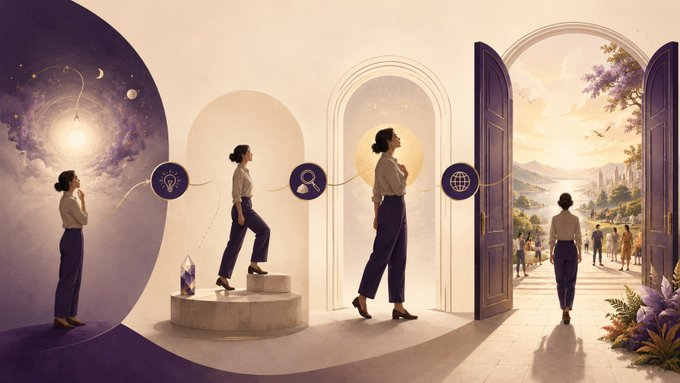
The Ideas Behind a Bigger Life
Vision is when the future becomes clear enough to matter. Not "I want more," but a real picture of what more actually means. People ruin this by keeping the dream vague and calling it ambition.
Prospection is your brain simulating what could happen before it happens. You already do this when you imagine failure, rejection, or embarrassment. The problem is not that you imagine. The problem is that fear often gets better screen time than possibility.
Mental contrasting means looking at the desired future and the current obstacle together. This is where fantasy grows teeth. You do not just imagine the better life. You ask what is standing in the way right now.
Implementation intention is the specific move you make when the obstacle appears. Not "I'll try harder." That sentence has betrayed millions of people. A better version is, "If I finish work tired, I go straight to the gym before I touch the couch."
Curiosity is the habit of entering new ideas, rooms, people, and situations instead of repeating what is already safe. Without curiosity, the world shrinks quietly.
Awe is what happens when life feels bigger than your little daily worries. A city, a mountain, a piece of music, a person operating at a high level. It pulls you out of the tiny self for a moment, and sometimes that moment is enough to make the old life feel too small.
This is where a lot of self-improvement content gets it wrong. It tells people to visualize the dream and feel it deeply. Fine. That can create emotion. But emotion without a bridge to behavior becomes entertainment. You feel inspired, then you return to the same environment, the same habits, the same phone, the same people, and the same weak little loop.
A useful future does not only make you feel something.
It gives today instructions.
How to Use Mental Contrasting Without Lying to Yourself
Mental contrasting is simple enough to sound obvious, which is probably why people skip it. You imagine the future you want, then you put it next to the obstacle in your current reality. Not the fake obstacle. Not the noble one. The real one.
Not "I need more discipline."
Maybe the real obstacle is that you sleep late because night is the only time you feel in control. Maybe you avoid networking because you are terrified of being seen as useless. Maybe you keep saying you want to read, but the truth is that reading makes you confront how scattered your attention has become. Maybe you keep delaying the project because once you release it, people can judge it, and right now the perfect imaginary version is still safe.
This is where imagination becomes uncomfortable in the right way.
- If you want to become more social, the real obstacle may not be "confidence." It may be that you wait for confidence before moving. The better plan is simple: if you enter a room, start one small conversation before checking your phone.
- If you want to build a better body, the real obstacle may not be discipline. It may be the dead zone after work where your brain starts negotiating like a weak little lawyer. The better plan is: if work ends, go straight to the gym before going home.
- If you want to become more intelligent, the real obstacle may not be lack of information. It may be that you consume ideas without wrestling with them. The better plan is: if you read or watch something, write five lines about what you think and why.
- If you want to finish a project, the real obstacle may not be quality. It may be fear of judgment hiding behind "I'm still improving it." The better plan is: if the draft is usable, publish the ugly first version.
- If you want to change your life, the real obstacle may not be motivation. It may be that your environment keeps voting for the old version of you. The better plan is: if the week feels predictable, add one unfamiliar room, person, or challenge.
The future alone is not enough. The obstacle alone is depressing. Put them together and the mind finally has something useful to work with.
How to Create New Evidence When Your Mind Feels Small
A life beyond imagination does not start with a massive leap. Most of the time, it starts with a very small insult to your old pattern.
You go to the event alone. You ask the question. You apply before you feel ready. You read something outside your usual little intellectual neighborhood. You talk to someone who does not already know your story. You change the room. You stop making your personality a prison sentence.
- "I'm shy."
- "I'm not disciplined."
- "I'm not a social person."
- "I'm not creative."
Fine, maybe that has been true. But people talk about themselves like the past is a legal document. It is not. It is evidence, not a verdict.
Evidence is what happens when imagination becomes behavior. You imagine being someone who can enter a new room, then you actually enter one. Badly, maybe. Awkwardly, probably. But now your brain has a new file. You imagine being someone who can speak clearly, then you practice explaining one idea without apologizing for existing. You imagine being someone who can build a better life, then you finish one small thing that the older version of you would have delayed.
- If your old prediction is "I can't go out alone," challenge it by sitting at a café alone for 30 minutes without hiding in your phone the whole time. The new evidence is simple, being alone in public does not kill you.
- If your old prediction is "I'm not interesting," challenge it by asking someone a real question and staying with their answer. The new evidence is that conversation can be built. You do not have to magically own it.
- If your old prediction is "I never finish things," challenge it by finishing one ugly version instead of improving it forever. The new evidence is that done exists, even when imperfect exists too.
- If your old prediction is "I'm not confident," challenge it by speaking first once in a small room. The new evidence is that confidence can follow movement.
- If your old prediction is "My life is boring," challenge it by doing one unfamiliar thing this week and writing what it showed you. The new evidence is that boredom may be underexposure, not personality.
This is why "dream bigger" is not enough. It sounds nice, but it is incomplete. Dreaming bigger without living wider creates frustration. You can sit in the same room, live the same week, talk to the same people, avoid the same discomfort, and imagine a massive life until your brain gets tired of your own speeches. Nothing happens because the environment keeps voting for the old self.
How Curiosity Makes Your Life Larger
Curiosity is not just a cute personality trait. It is one of the main ways a person expands their world. Research connects curiosity with exploration, learning, engagement, and well-being. In normal language, curiosity keeps your life from becoming stale because it keeps feeding your mind new material. [2]
A curious person keeps collecting new inputs, new rooms, new ideas, new people, new situations. Not all of them are useful. Some are boring. Some are stupid. Some are a waste of a Thursday night. But even a useless experience can stretch the border of what your mind thinks life contains.
A non-curious person has a shrinking world. They may still move around, but psychologically they keep visiting the same places. Same opinions. Same jokes. Same emotional reactions. Same kind of people. Same safe conclusions. Nothing gets in. And when nothing gets in, nothing truly new comes out.
That is the part people miss when they talk about "becoming better." They turn it into discipline only. Wake up early. Eat clean. Work hard. Repeat. That can help, of course. Structure matters. But a life beyond imagination is not built only through control. It is also built through contact. Contact with beauty. Contact with risk. Contact with smarter people. Contact with discomfort. Contact with silence. Contact with places that make your usual concerns look embarrassingly small.
How Awe Breaks the Small Version of You
There is a reason awe matters. Awe pulls you out of the little self. Stand under a sky that looks too big to belong to you. Walk through a city that makes your routine feel provincial. Watch someone perform at a level that makes your excuses sound ugly. Sit with an idea so large it makes your normal mental furniture look cheap.
Awe is not just a nice feeling. Research links awe to self-transcendence, meaning, and reduced self-focus. That matters because a lot of people are trapped inside themselves. Their fears, their image, their little reputation, their little anxieties, their little story about who they are. Awe interrupts that. It makes the self less suffocating for a moment, and sometimes that moment is enough to ask a better question. [3]
Not "how do I protect the life I already know?"
A better question is, "what kind of life would make this version of me look underdeveloped?"
That is an uncomfortable question because it does not let you hate your current self, but it also does not let you worship it. It treats the current version as material. Not trash. Not perfection. Material. Something to work with.
How to Stop Waiting for Confidence Before You Move
A lot of people try to skip the evidence stage. They want the identity first. They want to feel confident before doing the thing that produces confidence. They want to feel intelligent before entering conversations that expose what they do not know. They want to feel socially natural before surviving the clumsy first attempts. They want to feel like a creator before making bad work in public.
The order is usually uglier than that.
You act before the identity feels fully real, then the identity slowly catches up. You do not become brave and then enter life. You enter life, shake a little, survive it, and your brain becomes less dramatic next time. This is not poetic. This is practical. The mind updates through experience, especially experience that violates old predictions.
If you thought going alone would be humiliating, then went alone and had a decent time, your imagination changes. If you thought talking to strangers would destroy you, then one stranger responds warmly, your imagination changes. If you thought you were lazy, then you finish something for seven days, your imagination changes. Not because you lied to yourself. Because the evidence changed.
How Your Environment Decides What You Think Is Possible
People underestimate how much their imagination is borrowed from the people around them. If everyone around you treats ambition like arrogance, you will shrink your desires to stay loved. If everyone around you treats curiosity like weirdness, you will start hiding the best part of your mind. If everyone around you has accepted a life they do not even like, your own dissatisfaction may start to feel dramatic instead of intelligent.
This does not mean you need to cut everyone off and become one of those people who treats growth like a cult. That is its own little disease. It means you need contact with people and environments that make your next version feel normal. Not guaranteed. Normal. There is a huge difference between wanting something in a room where nobody believes in it and wanting something in a room where people discuss it like it is simply work.
A bigger life often begins when the impossible becomes socially normal.
You meet someone who casually does something you thought was rare. Runs a business. Travels alone. Speaks well. Builds a body. Studies deeply. Handles conflict directly. Lives with taste. Has standards. Suddenly your brain loses one excuse. Not all of them. Humans are creative little lawyers when defending comfort. But one excuse dies, and that matters.
How to Build a Life Your Old Self Could Not Predict
Imagination needs discipline or it turns into theater. There is a difference between imagining a future and escaping into one. Escapist imagination avoids the present. Productive imagination returns to it with instructions. After the vision, there has to be a question: what does this ask of today?
Not your whole life. Today.
A larger life is built through very small negotiations with the present. If the imagined future includes health, what is the smallest health action today? If it includes intelligence, what is the thought you will actually wrestle with today? If it includes social confidence, who will you speak to today? If it includes freedom, what skill or asset gets built today? If it includes love, what pattern in you needs to stop poisoning closeness?
A healthier life asks you to move your body, eat like you are not trying to sabotage yourself, and sleep with some respect. What you need to avoid is turning health into an identity costume.
A more intelligent life asks you to read, question, write your opinion, and talk to people who think differently. What you need to avoid is consuming smart content passively and calling that growth.
A more social life asks you to start small conversations, accept invitations, and create plans instead of waiting to be rescued by someone else's confidence. What you need to avoid is calling avoidance "peace."
A freer life asks you to build rare skills, reduce useless spending, and create leverage. What you need to avoid is fantasizing about freedom while protecting every comfort that keeps you stuck.
A more meaningful life asks you to do work and build relationships that connect to your values. What you need to avoid is mistaking busyness for purpose.
The phrase "a life beyond imagination" can sound like fantasy if you let it. It can sound like yachts, perfect mornings, mountain views, and a version of yourself who somehow has flawless skin and never procrastinates. That is not what I mean. I mean a life that becomes larger than what your old mind could predict.
There is nothing mystical about that. It happens all the time. Someone learns a language and suddenly another culture becomes emotionally available. Someone starts training and suddenly their body is not just a thing they drag around. Someone speaks to strangers and suddenly the world has more doors. Someone reads seriously and suddenly their own thoughts stop being so cheap. Someone leaves a dead environment and suddenly their personality comes back like it was waiting outside the whole time.
The life was not impossible. It was unimaginable from the old position.

How to Start This Week Without Turning It Into Another Fantasy
The danger is that people read something like this and turn it into another pleasant thought. They nod. They feel a little awake for five minutes. Then they go back to the same life and call the feeling insight. But insight that never touches behavior is just entertainment with better vocabulary.
So the practical question is not "what life can I imagine?"
The better question is, "what action would make my current imagination obsolete?"
That is sharper. It forces movement. It asks you to do something your current self cannot fully understand yet. Not because you are reckless, but because the mind updates after contact. You do not think your way into every version of life. Sometimes you have to enter a room first and let the room correct you.
Pick one thing this week that gives your brain new evidence. Not a giant transformation. Those are often just procrastination wearing dramatic clothes. Pick one thing that slightly expands what you think is possible. Go alone. Ask. Apply. Write. Train. Call. Visit. Start. Finish. Say the real sentence. Sit with the difficult idea. Let yourself be bad at the beginning without turning it into a personality crisis.
A life beyond imagination is not built by escaping reality. It is built by feeding reality enough new experiences that the imagination has no choice but to grow. And once imagination grows, the old life starts to feel too tight.

Quick answers
What does a life beyond imagination mean?
It is the gap between the life your mind is used to predicting and the life that could become possible if you stopped treating your current reality like the edge of the map. Not yachts and fantasy — a life larger than what your old mind could predict.
What is mental contrasting?
You imagine the future you want, then put it next to the real obstacle in your current reality. The future alone is not enough. The obstacle alone is depressing. Together they give the mind something useful to work with.
How do you expand your imagination?
You need new evidence, not endless thinking. Act before the identity feels fully real, challenge old predictions with small actions, and seek contact with people and environments that make your next version feel normal.
Is your week already written before it starts?
Take the free 2-minute Drift Test. No email. Find where your life stopped surprising you — and what Mauve would interrupt first.
Take the Drift Test