Most people are busy. They answer messages. They show up to work. They sit with their laptop open. They make plans. They say yes to tasks. They write lists. They look like they are trying. From the outside, nothing looks broken.
But inside the day, something is leaking.
They start one thing, check another, remember a third, open a tab, answer one message, think about a conversation from earlier, tell themselves they are still working, then somehow two hours disappear and nothing meaningful has moved. Not because they did nothing. Because they did a lot of half-things.
That is the dangerous version of drifting.
Not doing nothing.
Doing enough to feel busy, but not enough to change the day.

Start With What Focus Actually Is
Before any discipline talk, get the definition clean.
Focus is not sitting at a desk. Focus is not having a clean Notion page. Focus is not writing a to-do list with little checkboxes like you are auditioning for a productivity app commercial.
Focus is attention pointed at one meaningful target long enough to produce movement.
That is it.
One target. Enough time. Real movement.
Most people lose focus before they even start because they do not have one target. They have a pile. "Work on the project." "Study." "Be productive." "Fix my life." These are not targets. These are fog with ambition.
A real target sounds different.
- Finish the intro section.
- Solve ten questions.
- Send the proposal.
- Record the first draft.
- Apply to three places.
- Write 500 ugly words.
- Review the meeting notes and extract the next move.
Specific enough that you can tell if it happened.
That matters because your brain loves vague work. Vague work gives you the emotional reward of trying without the humiliation of measurement. You can spend three hours "working on yourself" and nobody can prove you did nothing. Cute. Useless, but cute.
If the task cannot be measured, it can be performed forever.
So the first fix is not motivation. It is definition. What exactly are you doing, and what counts as done?
That question makes people uncomfortable because it removes the fog they were hiding inside.
The Real Problem Is Not Distraction, It Is Unfinished Attention
People talk about distraction like it is always external. The phone. The notifications. The noise. The group chat. The algorithm. Sure, those are real. But they are not the whole crime scene.
The uglier problem is unfinished attention.
You leave one task, but part of your mind stays there. You answer a message, then return to work, but your brain is still replaying the message. You jump from studying to checking something "quickly," then come back with your attention smeared across both places. You technically returned. Your mind did not.
Research on attention residue shows that when people switch between tasks, part of their attention can remain stuck on the previous task, making the next task harder to perform well. That explains the feeling perfectly. You are at the desk, but not fully inside the work. You are present physically and scattered mentally.
This is why "just multitask better" is a bad plan.
You do not need to become better at switching. You need fewer reasons to switch.
Build Blocks, Not Wishes
Here is where discipline becomes practical.
A person who relies on motivation wakes up and asks, "Do I feel like doing this?"
Wrong question. Terrible little trap.
A person with a system asks, "What block am I in?"
That difference sounds small. It is not.
A wish depends on mood. A block depends on structure. A wish says, "I should study today." A block says, "From 10:00 to 11:30, I solve past exam questions, phone away, no switching." One is a nice intention. The other has walls.
Good focus needs walls.
A start time. An end time. A task. A definition of done. A rule for interruptions. A transition after it ends.
Without those walls, the day becomes soft. And soft days get eaten.
Not dramatically. Quietly. One small delay at a time.

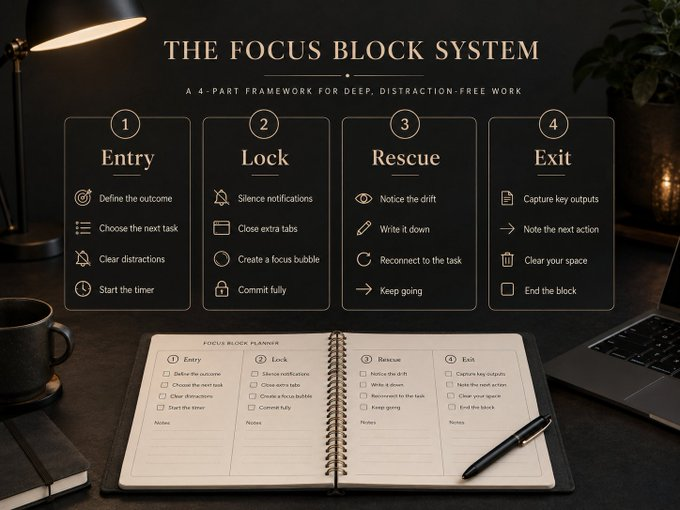
The Focus Block Has Four Parts
The entry
This is where people already start losing. They say they will begin at 10:00, then at 10:07 they are still "getting ready." Water. Music. Messages. One more thing. The laptop update. The room is not right. Their brain suddenly becomes a luxury hotel inspector.
No. The entry needs to be boring and repeatable. Sit down. Open the task. Remove the obvious distractions. Start ugly. That is all.
The lock
This is where the task becomes the only thing allowed to matter. Not forever. Just for the block. You are not deciding your whole life. You are not becoming a new person. You are protecting ninety minutes from being murdered by everything that feels easier.
The rescue
This is the part most productivity advice skips because it wants humans to act cleaner than they are. You will drift. You will get restless. You will want to check something. You will suddenly remember an unrelated task that feels urgent because your brain is trying to escape.
Fine. Expect it.
A rescue rule says, "If I drift, I write the distraction down and return to the task." Not negotiate with it. Not follow it. Not shame yourself for having a brain that behaves like a bored animal. Just park it and return.
The exit
When the block ends, you do not just collapse into the nearest cheap dopamine source. You close the loop. What got done? What is left? What is the next move? This matters because open loops create mental noise later. If you finish without defining the next step, the task keeps haunting the background of your day.
That is how attention leaks.
Stop Calling Autopilot "Rest"
Autopilot is not rest.
This needs to be said because people lie about this constantly.
Real rest gives something back. Autopilot takes something and leaves you foggier than before. Rest is a walk, a meal without your phone, sleep, a real conversation, sitting outside, training, music, prayer, silence, whatever actually restores you. Autopilot is scrolling for forty minutes and coming back with your brain feeling like wet cardboard.
The problem is that autopilot often wears the costume of rest.
"I need a break."
Maybe you do. But if the break leaves you more drained, more avoidant, and more annoyed at yourself, that was not rest. That was escape with a nicer name.
This is where discipline gets misunderstood. Discipline is not forcing yourself to work all day. That is how people become productive and dead-eyed, very impressive little corpses. Discipline is knowing the difference between recovery and disappearance.
A focused person rests on purpose.
A drifting person escapes by accident.
The outside may look the same. Couch, phone, food, silence. But the intention is different, and the result is different. One brings you back. The other makes coming back harder.
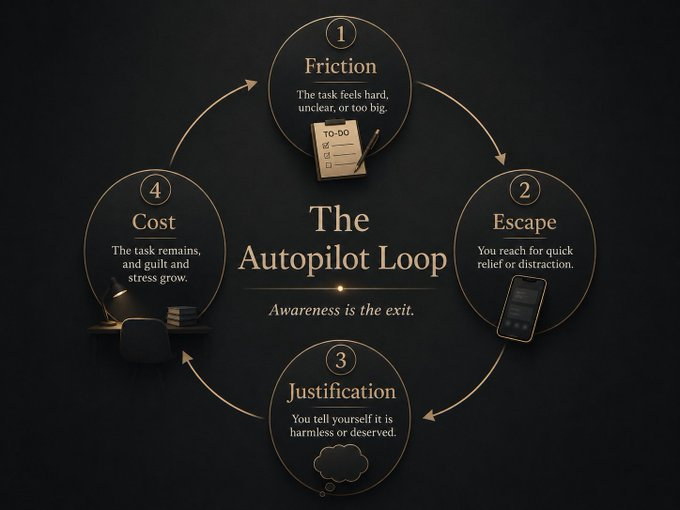
The Autopilot Loop
Autopilot usually follows a pattern.
First, there is friction. The task feels unclear, boring, uncomfortable, too big, or too emotionally loaded. Then there is a soft escape. You check something, delay something, clean something, open something, message someone. Then comes the justification. "I worked hard." "I need balance." "I'll do it later." "It only took a few minutes." Then comes the cost. The task is still there, but now it feels heavier because you broke trust with yourself again.
That loop repeats until it starts looking like personality.
I'm just not disciplined.
Maybe. Or maybe you have repeated the same loop so many times that your brain now runs it without asking you.
This is why pattern tracking matters more than motivation. Motivation looks at today and says, "Try harder." Pattern tracking looks at the last three weeks and says, "You always disappear after work before the gym, so the problem is not the gym. The problem is the transition between work and home."
That is a completely different diagnosis.
And a better diagnosis gives a better fix.
Diagnose the Drift Before You Fight It
Do not attack the surface behavior too early.
If someone keeps skipping work, studying, gym, writing, outreach, or anything meaningful, the easy advice is to say, "Be more disciplined."
That advice is cheap because it does not ask what the behavior is doing for them.
Every repeated behavior has a function. Even the bad ones. Avoidance protects you from discomfort. Procrastination protects you from judgment. Overplanning protects you from starting. Constant learning protects you from being tested. Scrolling protects you from silence. Staying busy protects you from noticing that the important thing is still untouched.
So before you fix the drift, ask what it is protecting:
- Is the task unclear?
- Is it too large?
- Is the first step ugly?
- Is there fear of being judged?
- Is the environment pulling you elsewhere?
- Are you tired in a real physical way?
- Are you avoiding the identity that comes with doing the task?
That last one matters more than people admit. Sometimes the task is not hard. The identity shift is. If you actually write, you are not just "thinking about writing" anymore. If you actually post, you are not just "planning content." If you actually train, you are no longer the person who talks about getting in shape. Action removes the fantasy version and replaces it with evidence. People say they want that until it starts becoming real.
Use the Smallest Serious Version
A lot of discipline fails because people make the task too dramatic.
They do not want to work out. They want to start a six-day training arc.
They do not want to read. They want to become a person who reads fifty books.
They do not want to focus. They want to rebuild their entire life by Monday.
Relax. You are not a movie trailer.
The smallest serious version is the smallest action that still respects the goal.
Not the smallest fake version. Not opening the book and staring at it like a decorative intellectual. Not putting gym clothes on and calling that a win while your body remains untouched by effort. The smallest serious version still has teeth.
- Twenty minutes in the gym.
- One page of real writing.
- Ten focused questions.
- One uncomfortable message.
- One clean hour without switching.
A small serious action is powerful because it lowers the entry cost without lying about the purpose. It gets you moving without asking your mood for permission. And once you are moving, the task often becomes less dramatic because the brain stops imagining it and starts dealing with it.
Most resistance lives before the start.
That is why the start should be small, clear, and difficult enough to count.
Make the Day Harder to Waste
The best daily structure is not the one that looks impressive. It is the one that reduces drift.
A beautiful schedule that collapses at the first inconvenience is decoration. A useful day plan has pressure points. It knows where you usually break. It knows what needs to happen before the task. It knows what you will do when you lose focus. It knows what comes after.
You do not need every minute planned. That becomes exhausting and fake very quickly. But you do need the important parts protected.
- Morning direction.
- The first meaningful task.
- The main focus block.
- The transition after work.
- The time where you usually disappear.
- The night review where you stop lying about how the day went.
That is enough to change a day.
Not perfectly. Perfect is another way people avoid starting. But enough.
A good day plan is not there to control you. It is there to stop your weaker moods from making all the decisions.
How Mauve Applies This in Daily Life
This is where Mauve fits, but not as the main character. The advice is the main character. Mauve is just the system that keeps the advice alive when the user's mood starts acting expensive.
In the morning, Mauve does not need to ask, "How can I help you today?" That is lazy assistance. The better move is a morning walkthrough. What matters today. What is the first meaningful block. Where the likely drift points are. What needs to be prepared before the day starts eating itself.
Before a focus block, Mauve's job is to narrow the target. Not "work on the project." No. What part? What counts as done? How long are we protecting? What distraction is most likely to show up? That is the difference between a reminder and a useful assistant.
During the day, Mauve watches the gaps. If there is a two-hour empty space after a task, that is not automatically free time. It may be a drift zone. She can ask what that space is for, suggest a small useful move, or protect it as actual rest if rest is what the user needs. The point is not to stuff every gap with work. That is stupid. The point is to stop accidental nothing from pretending it was a choice.
After a missed task, Mauve should not instantly lecture. One miss can be noise. Two or three starts becoming a pattern. Then the better move is to name it clearly, ask what happened before it, find the actual blocker, and build the fix around that. If the user keeps skipping the gym after work, the fix may not be "more discipline." It may be "do not go home first." If the user keeps avoiding writing, the fix may be "publish a bad version before editing." If the user keeps wasting the night, the fix may be "decide the night before what the first hour is for."
That is how real assistance works.
Not by throwing motivation at the user.
By catching the loop.
The Weekly Reset Is Where Discipline Gets Honest
Daily discipline is messy. One bad day can happen for a hundred reasons. Bad sleep. Stress. Work. Family. Mood. Life being life.
But a week tells the truth better.
If the same task slipped three times, that is not random. If the same time of day kept collapsing, that is not bad luck. If every plan looked good at night and died by afternoon, the problem is not planning. The problem is that the plan is written for a fantasy version of the person.
Weekly review matters because it turns vague guilt into usable information.
- What kept slipping?
- Where did focus actually happen?
- What time of day was strongest?
- What time of day kept turning into fog?
- What was overplanned?
- What was avoided?
- What needs to be smaller?
- What needs more pressure?
- What needs to be removed because it keeps pretending to matter?
This is where Mauve becomes useful again. She can help the user stop treating every day like a fresh mystery. If the same pattern appears across the week, she should hold it up. Not cruelly. Clearly. "You keep planning deep work at night and keep failing it. So either your nights are not yours, or you are using the plan to feel serious without having to execute. Which one is it?"
That kind of question is uncomfortable. Good. A useful question should disturb the lie.

The Discipline Stack
The whole system is not complicated. People make it complicated because complexity feels safer than execution.
- Define the target.
- Protect the block.
- Expect the drift.
- Use a rescue rule.
- Close the loop.
- Track the pattern.
- Fix the real blocker.
- Review the week.
- Repeat with less drama.
That is discipline when you remove the motivational costume. It is not sexy. It is not cinematic. It is mostly the art of making fewer dumb decisions when your mood changes. And your mood will change. That is the whole point. A system that only works when you feel inspired is not a system. It is a mood with better branding.
The Stages of Getting Your Focus Back
The first stage is awareness. You start noticing the drift while it is happening instead of hours later. This is annoying at first because now you can see yourself doing the thing. But that is progress. A loop you can see is a loop you can interrupt.
The second stage is containment. You stop trying to fix your whole personality and start protecting one block, one transition, one repeated failure point. One hour of clean work. One gym transition. One night without disappearing. Small, but real.
The third stage is pattern control. You stop treating every failure like a moral crisis and start treating it like data. Same failure, same time, same excuse, same environment. Good. Now we know where to cut.
The fourth stage is identity proof. You start collecting enough evidence that the old story becomes harder to believe. You are not "trying to become focused" anymore. You have focused. You are not "trying to be disciplined" anymore. You have kept promises under imperfect conditions. Not all of them. Enough to make the old excuse weaker.
The fifth stage is life design. This is where focus stops being about tasks only. You begin shaping the environment, people, routines, work blocks, rest, and commitments around the kind of person you are building. Not perfectly. Just deliberately.
That is when discipline stops feeling like punishment and starts feeling like self-respect with structure.
What Actually Changes
The reward for focus is not just productivity. That is the boring answer. The real reward is that your life starts feeling less stolen. You stop ending the day with that dirty little feeling that you were present for none of it. You stop needing to lie about where the time went. You stop confusing motion with movement. You stop letting the easiest available thing decide the shape of your life.
Focus gives you your day back. Not all at once. Not magically. But block by block, choice by choice, rescue by rescue. You become harder to pull away from yourself. That is what discipline is supposed to do. Not make you robotic. Not make you obsessed with work. Not turn your life into a spreadsheet with shoes. Discipline is supposed to give you enough control over your attention that your actual values have a chance to survive the day. Because drifting is not harmless. A drifted day becomes a drifted week. A drifted week becomes a drifted identity. Then one day you look at your life and realize nothing dramatic ruined it. You just kept letting the day happen to you.
So start smaller than your ego wants.
Pick the next block.
Define what done means.
Remove the obvious escape.
When you drift, return without making a speech.
At night, look at what actually happened.
And when the same pattern repeats, stop calling it a rough day.
Call it what it is.
A loop asking to be broken.
Quick answers
What is focus?
Focus is attention pointed at one meaningful target long enough to produce movement. One target, enough time, real movement — not a clean to-do list or a laptop that stays open.
What is the autopilot loop?
Friction leads to a soft escape, then justification, then cost — and the task is still there, heavier than before. The loop repeats until it starts looking like personality.
What is a focus block?
A focus block has four parts: entry (start ugly), lock (protect the time), rescue (write distractions down and return), and exit (close the loop and define the next move).
Find where your day starts leaking.
Take the free 2-minute Drift Test. No email. You get your Autopilot Score, the mechanism behind it, and what Mauve would interrupt first.
Take the Drift Test